Have you noticed how much stuff is out there now?
Blog posts. LinkedIn threads. Newsletters. Landing pages. Cold emails that sound assembled instead of written.
Some of this output is useful. A lot of it is not. The visible symptom has a useful name: AI slop.
But AI slop is not simply "content made with AI." That definition is too lazy. A thoughtful article drafted with an AI assistant, checked by a human, supported by evidence, and revised with taste is not slop. A human-written page that pads 900 words around nothing is still slop.
The problem is output without judgment.
AI made it easy to produce more.
It did not make it easy to produce work that deserves attention.
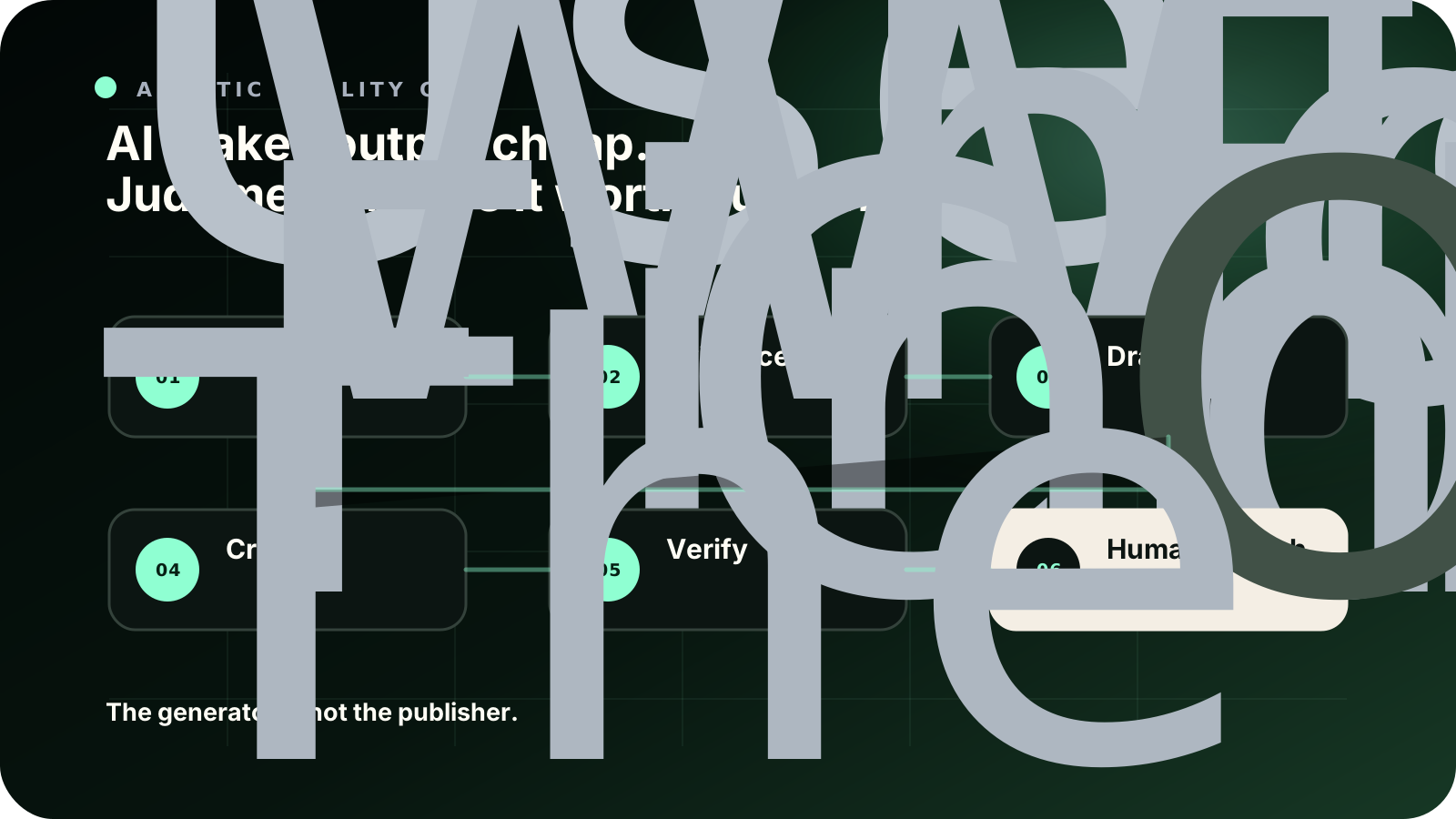
The new skill is not prompting an AI agent to generate output. The new skill is designing a workflow where agents research, draft, critique, verify, and improve the work before a human takes responsibility for shipping it.
What AI Slop Really Is
I would define AI slop like this:
AI slop is output produced faster than it is understood, reviewed, or made useful.
That definition matters because it includes more than writing. A slop blog post is obvious. A slop product feature is worse. A slop data analysis can mislead a team. A slop customer support reply can sound polite while failing to solve the problem. A slop code change can pass a shallow glance and then break the real user path.
AI agents make this more serious because agents do not only write. They can use tools, call APIs, browse files, summarize tickets, draft replies, open pull requests, schedule tasks, and trigger workflows. The output is no longer just a paragraph in a chat window. It can become an action.
That is why quality guardrails matter.
Not guardrails that make AI timid. Not corporate theater where every workflow has a checklist nobody reads. I mean practical guardrails on how we use AI so that speed does not quietly replace care.
The generator is not the publisher. The publisher is the person or organization that puts its name, reputation, user trust, and consequences behind the output.
Lines Worth Citing
If you want the argument in compact form:
The generator is not the publisher.
The first draft is no longer scarce, but good judgment still is.
Why The Flood Is Real
AI adoption has crossed from novelty into infrastructure. That matters because it changes the economics of ordinary work: the first draft is no longer scarce, but good judgment still is. Stanford's 2025 AI Index, drawing on McKinsey survey data, reported that 78% of surveyed organizations used AI in at least one business function in 2024, up from 55% the year before. The 2026 AI Index reports the number moving higher again, with organizational adoption reaching 88%. Those figures are survey-based, so they should be read directionally, but the direction is not subtle.
In practical terms, the first draft of many things has become cheap: article drafts, landing pages, product copy, emails, summaries, reports, scripts, and support replies. The constraint moved from production to selection. Everyone can generate. Fewer people can decide what is worth keeping.
Search guidance points in the same direction. Google does not say "AI content is bad." Its helpful content guidance focuses on whether content is useful, reliable, and made for people. Its spam policy targets scaled content abuse: large amounts of unoriginal content made primarily to manipulate ranking and not help users, regardless of how the content is created.
The issue is not automation. The issue is value.
If a page exists only because it was cheap to generate, it probably should not exist. If a page helps a real person understand, decide, compare, build, debug, buy, avoid a mistake, or see something more clearly, the method of drafting matters less than the quality of the final artifact.
There is a deeper technical warning here too. Research on model collapse shows that recursively training models on generated data can degrade future models. There may be a parallel human version of the same risk: when everyone remixes summaries of summaries, the original signal gets thinner. First-hand experience, real testing, and specific examples become more valuable, not less.
The Agentic Quality Gate
A single chatbot can help draft text. An AI agent can participate in a process.
That process can be sloppy or disciplined. It can turn one vague prompt into ten vague outputs. Or it can force useful friction into the workflow: retrieve evidence, test assumptions, critique the draft, verify claims, check policy, simulate user behavior, and ask a human to approve the final version.
OpenAI's Agents SDK documentation describes guardrails around inputs, outputs, and tools. Anthropic's agent guidance makes a related point from another direction: agentic systems are useful when the task benefits from tool use, context, iteration, and feedback. NIST's AI Risk Management Framework gives the broader governance language: map the context, measure risks, manage them, and govern the system.
For practical work, I would use one quality gate stack:
| Gate | Agent role | Human decision |
|---|---|---|
| Intent | Clarify the reader, user, goal, and promise. | Is this worth making at all? |
| Evidence | Gather sources, examples, logs, screenshots, tests, or first-hand notes. | Is the support strong enough? |
| Draft | Produce a useful first version, not a final artifact. | What is worth keeping? |
| Critique | Find weak claims, repetition, vague language, and missing examples. | Which critique matters? |
| Verify | Check links, numbers, dates, names, code paths, and UX states. | Is the risk acceptable? |
| Publish | Prepare the final artifact and checklist. | Would I put my name on this? |
The value of agents is not that they let you skip judgment. It is that they can make judgment easier to apply at more points in the process.
A Worked Example: Publishing An AI-Assisted Article
Suppose you want to publish an article on a complex topic. The fast way is obvious: ask a model for a draft, skim it, publish it.
That is how the mush gets made.
A better workflow uses agents as a quality system.
1. Brief Before Draft
The brief agent does not write the article. It refuses to start until the premise is clear.
It asks:
- Who is the reader?
- What problem are they trying to solve?
- What is the main claim?
- What would make the article worth saving or sharing?
- What should not be included?
- What experience or examples does the author bring that a generic model would not know?
This step matters because most bad AI writing starts with a vague prompt and then spends 1,500 words pretending the prompt was not vague.
A good brief turns "write about AI slop" into something sharper:
Write for builders, creators, and teams using AI agents.
Argument: the advantage is no longer generation speed, but quality gates.
Avoid: moral panic, AI-bad framing, generic productivity advice.
Include: agent workflow, concrete gates, examples for content and product work.
2. Research Before Authority
The research agent builds the source pack. A weak research agent returns links. A useful one returns links plus the claim each source can support, the date of the source, and any caveat.
For example, the Stanford AI Index is useful for saying AI adoption is mainstream. It is not proof that every person is publishing more content. Google Search guidance is useful for arguing that helpfulness matters more than whether AI was used. It is not proof that your article will rank.
That distinction prevents fake certainty.
3. Draft As Raw Material
The draft agent should not be asked to sound impressive. It should be asked to be useful.
A weak instruction is:
Make this viral and thought-provoking.A better instruction is:
Write a clear first draft. Prefer concrete examples over slogans. Flag claims that need verification instead of inventing support. Do not hide uncertainty. Do not use filler transitions.The first draft is still only a draft. Treating it as publishable because it is fluent is the oldest mistake in the current AI workflow.
4. Critique Before Polish
The critic agent should be useful, not polite. Its job is to find where the author is getting away with something:
- The thesis repeats but does not advance.
- A section makes a claim without evidence.
- A paragraph sounds polished but says nothing.
- A list is too exhaustive and not selective enough.
- The conclusion restates the intro instead of earning its ending.
- The voice sounds borrowed instead of owned.
This is where many AI-assisted pieces can be saved. The critic agent is not there to encourage you. It is there to protect the reader.
5. Verify Before Shipping
The fact agent checks the fragile parts: numbers, dates, links, names, citations, quotes, product claims, and anything that could embarrass you later.
It should produce a boring table:
| Claim | Status | Evidence | Fix |
|---|---|---|---|
| "Stanford 2025 AI Index reported 78% organizational AI use in 2024." | Verified | Stanford AI Index 2025 | Keep, with survey caveat. |
| "Google penalizes all AI content." | False | Google Search guidance | Replace with scaled content abuse framing. |
| "Everyone is using agents." | Unsupported | No source | Narrow the claim. |
Fluent writing lowers suspicion. If a sentence sounds clean, you are more likely to believe it. That is convenient for communication and dangerous for accuracy.
6. Human Edit Before Publication
The human edit is where ownership enters.
This is not ceremonial. The human should read the piece like a reader, not like a person trying to finish a task. Cut what is padded. Add what only you know. Replace generic examples with real ones. Remove sentences that only decorate the argument.
My minimum rule is simple: if AI drafted it, I need to read it at least twice before publishing. Once for meaning. Once for trust.
The second read catches different problems. The first read asks, "Does this make sense?" The second asks, "Would I put my name on this?"
Beyond Writing: Products, Emails, And Support
The same pattern applies anywhere AI output reaches another person.
| Surface | Common slop pattern | Better quality gate |
|---|---|---|
| Product feature | The happy path works, but bad input breaks the experience. | Ask an agent to test malformed data, mobile layout, empty states, and first-time-user confusion. |
| Support reply | The answer sounds polite but does not solve the user's problem. | Require the agent to cite the ticket facts, state uncertainty, and route risky cases to a human. |
| Sales email | The structure is correct but nothing proves the sender cared. | Ask whether you would want to receive it, then cut half the words. |
| Data summary | The narrative sounds confident but hides missing or messy data. | Require the agent to list assumptions, excluded rows, and confidence level. |
| Code change | The patch compiles but the user path was never exercised. | Ask the agent to run or describe the real scenario, edge cases, and rollback path. |
A product feature should not be judged only by whether it exists. It should be judged by whether it survives the confused user, the impatient user, the mobile user, the bad-data user, and the user who does exactly what your onboarding did not expect.
AI agents are good at generating those scenarios. Humans are still needed to decide which ones matter most.
Why SEO Gets Better When You Stop Chasing SEO
The worst reaction to AI content saturation is to produce more pages because keywords exist. That strategy creates exactly the kind of low-value scaled output search systems are trying to avoid.
The better strategy is simpler and harder: make the page useful enough that a real reader would be satisfied after reading it.
A page built for humans and search engines should have:
- a clear title that matches the real topic,
- a direct answer to the reader's problem,
- examples that are not copied from everyone else,
- sources for factual claims,
- internal links where they genuinely help,
- headings that make the structure legible,
- enough depth to satisfy the query,
- enough restraint to avoid wasting the reader's time.
Clear definitions, specific examples, named concepts, and well-structured arguments also make the page easier for other people to cite, summarize, and return to. Vague paragraphs that circle the same point do not travel well.
Search does not need you to sound more like a content machine. It needs you to be easier to trust.
A Small Team Policy That Actually Works
If a team wants to use AI agents without producing slop, start with a working agreement small enough to follow.
| Rule | Practical meaning |
|---|---|
| No unowned output | Every published artifact has a human owner. |
| No source-free factual claims | Dates, numbers, legal claims, medical claims, financial claims, and public claims need evidence. |
| No direct publish from generation | AI output goes through review before it reaches users. |
| No hidden uncertainty | If the system is unsure, the output should say so or route to a human. |
| No fake personalization | Do not pretend to know the user if the system does not know them. |
| No silent tool actions | Agents that change data, send messages, or publish content need permissions, logs, and rollback paths. |
| No quality theater | A checklist is only useful if it blocks bad work. |
You can encode these as input guardrails, output guardrails, tool guardrails, approval steps, evals, checklists, or review workflows. The mechanism depends on the system. The principle is stable: the workflow should make careless output harder to ship.
The Anti-Slop Checklist
Before publishing or shipping AI-assisted work, ask these questions in the open. The first six map to the six gates above. The seventh is the ownership test that decides whether the work is ready to leave your hands.
- Purpose: Can I explain who this is for in one sentence?
- Promise: Does the output fulfill the title, subject line, or feature promise?
- Evidence: Are factual claims sourced, tested, or clearly based on first-hand experience?
- Specificity: Did I include examples concrete enough that a reader can apply them?
- Critique: Did I ask what is weak, repetitive, unsupported, or generic?
- Verification: Did I check links, numbers, names, dates, code paths, or UX states?
- Ownership: Would I put my name on this without blaming the model later?
If the answer to the last question is no, the work is not ready.
Continue Reading
These pieces extend the workflow side of the argument:
- Stop Planning Everything. Start Writing Agent Skills. explains how to turn repeated standards into reusable agent context instead of re-prompting every time.
- AI Agents Need Better Outputs Than Markdown explains why high-quality agent work often needs artifacts, diagrams, and interfaces, not just text.
- Build a Production-Ready AI Agent in Python shows the agent loop, tool calling, and reliability patterns behind systems that can survive real use.
What To Do On Monday
Pick one piece of AI-assisted work this week before it ships: a post, product page, feature, support flow, sales email, report, or code change.
Run it through the six gates and the ownership test above. Do not make the process grand. Just make it real. Ask one agent to critique it, one agent to verify it, and one human to decide whether it deserves to go out.
That is the new quality bar.
Not more output.
Better ownership of the output we already know how to generate.