Most people meet the math behind machine learning the same way: a wall of symbols in a textbook or a course, read once, half understood, then quietly skipped. The ideas are not actually hard. They are just badly served by sitting still on a page. A gradient is a direction. A dot product is an angle. A derivative is a slope. These are things you can see and move, and the moment you can move them, they stop being scary.
So I built a place to move them. The Machine Learning Math Lab is a free tool that runs in your browser and turns the four pieces of math under almost every model into things you can drag, slide, and watch. No setup, no sign-in, and nothing leaves your browser.
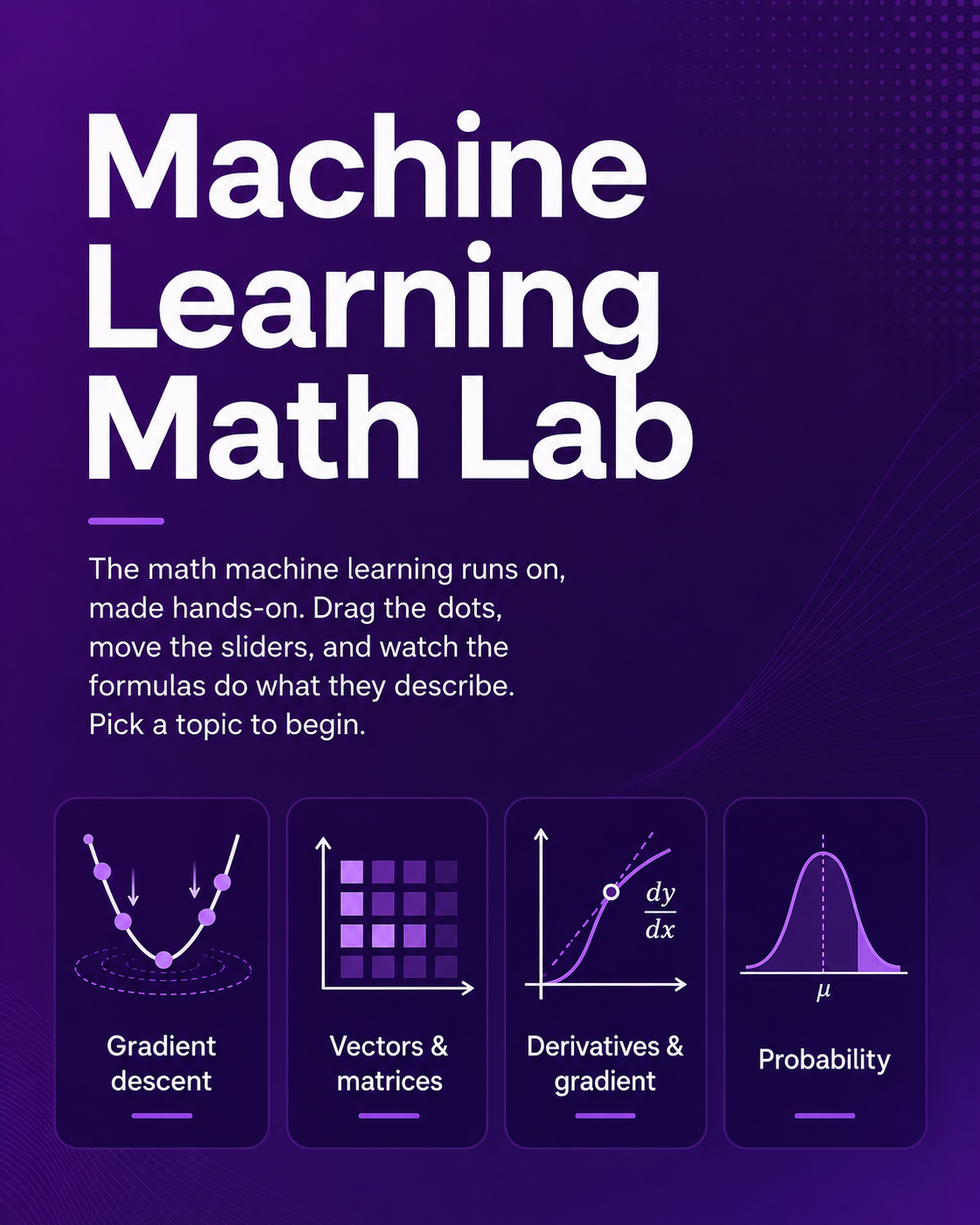
What is inside
Four modules, each a live visual with controls and a short lesson. You can poke at any of them in any order.
Gradient descent. Drag a dot onto an error surface, set the learning rate, and press Run. Watch it roll to the bottom. Then turn the learning rate up and watch it overshoot the valley and fly off, or stretch the bowl into a ravine and watch the path zig-zag. This is the one loop nearly all training uses, and seeing it misbehave teaches more than any definition.
Vectors and matrices. Drag two arrows around and watch their dot product go positive, hit exactly zero at a right angle, then go negative. Flip to the matrix view and bend the whole grid with four sliders, so you can finally see what people mean when they say a layer "transforms" your data.
Derivatives and the gradient. Slide a point along a curve and read its slope changing sign at the peaks and valleys. Step up to a surface and see the gradient as an arrow that points uphill, with gradient descent simply walking the other way. The first module suddenly makes sense.
Probability. Shape a bell curve with two sliders, sample it, and watch random draws pile up into the curve. Then meet the base-rate trap in a Bayes visual: drop how common a condition is and watch the false alarms swamp the true cases, which is exactly why accuracy alone lies on rare events.
The theory is right there too
Under each visual is a "Learn it step by step" lesson: six short steps that build the idea from scratch and then point you at the exact slider or dot to try. Read a step, do the thing, move to the next. You are never sent off to another tab to look something up.
It is intuition-first on purpose. Plain language leads, the real formulas are shown gently with every symbol named, and the four topics cross-reference each other so they read as one connected story rather than four disconnected lessons.
Who it is for
Students who want the math to click before the exam. Self-taught builders who use machine learning tools every day but feel the math is a black box. Anyone who has nodded along to "just take the gradient" and wanted to actually see what that means. If you can use a chatbot, you can use this.
Open it
The lab is here: Machine Learning Math Lab. It works on a phone too, so you can drag a loss surface around on the train.
If it leaves you wanting the engineering side of this math, two pieces on this site go deeper: What Actually Makes an AI Agent Loop Work builds on the same gradient-and-optimization ideas, and RAG Is an Evidence System leans on the vector and dot-product intuition from the lab. Start by playing, then read.